About Me
Hi and thank you for stopping by!
Let me use this opportunity to present myself.
Being initiated to hard puzzles at an early age through MYST by my dad, I developed a passion for figuring out how things work. I am now a physicist, because I like to describe them with a clear and precise language and a Python programmer, because I also like contradictions.
In the last years I dived into the amazing field of accelerator physics, while at the same time developing my coding skills - from “physicist” to “readable” and sometimes even “nicely documented” - thanks to the help, inspiration and criticism from very talented colleagues.
Check out my Google Scholar for the science part and my Github for the codes.
Experience
CERN
Postdoctoral Researcher (Fellow)
Mar 2023 - Feb 2026
European Organization for Nuclear Research, Geneva, CH
Research in accelerator physics, especially in the measurement and correction of LHC and HL-LHC beam optics.
Simulation and data analysis campaigns.
Software maintenance, development, refactoring and testing of analysis tools and graphical user interfaces in Python and Java.
CERN
PhD Student
Sep 2019 - Nov 2022
European Organization for Nuclear Research, Geneva, CH
Thesis Title: “Corrections of high-order nonlinearities in the LHC and High Luminosity LHC beam optics”.
Under the caring supervision of Dr. Rogelio Tomás-García.
CERN
Researcher (International Volunteer)
Sep 2017 - Sep 2019
European Organization for Nuclear Research, Geneva, CH
Research in accelerator physics, especially in the measurement and correction of beam optics.
Simulation and data analysis campaigns.
Software development of analysis tools and graphical user interfaces in Python and Java.
HHI
Research Assistant
Aug 2015 - Dec 2015
Fraunhofer Heinrich Hertz Institute, Berlin, DE
Development of a Python-based interface between VPI Photonic Components and MATLAB.
HHI
Student Research Assistant
Dec 2013 - Aug 2015
Fraunhofer Heinrich Hertz Institute, Berlin, DE
Masters Thesis: Quality-of-transmission estimation in physical impairment-aware flexible optical networks.
Digital Signal Processing and Performance Monitoring in Flexible Optical Networks: MATLAB/VPI Photonic Components simulations.
DSP-Toolbox development.
BAM
Intern
Mar 2013 - May 2013
Bundesanstalt für Materialforschung und -prüfung, Berlin, DE
Acoustic wave propagation in waveguides: SB-FEM simulations in MATLAB continued (Acknowledgement).
BAM
Intern
Apr 2012 - Jul 2012
Bundesanstalt für Materialforschung und -prüfung, Berlin, DE
Acoustic wave propagation in waveguides: SB-FEM simulations in MATLAB.
ABB
Intern
Sep 2011 - Dec 2011
ABB Switzerland Ltd. (ABB Schweiz AG), Baden Dättwil, CH
Implementation of surface plasma interaction models as boundary conditions for electrical current calculations: FEM Simulation in MATLAB (Reference).
Education
Humboldt University of Berlin
PhD
2019 - Present
I am currently writing my PhD Thesis “Corrections of high-order nonlinearities in the LHC and High Luminosity LHC beam optics”.
Expertedly supervised by Prof. Dr. Andreas Jankowiak,
who made my start at CERN already much easier by providing me with his lecture materials beforehand.
Technical University Berlin
Master's degree in Physics
2012 - 2016
With the background of my bachelor’s studies, the fundamental physics course at the TU-Berlin were the logical choice on the way to obtain a master’s degree.
After a short intermezzo as an intern at ABB and BAM to get an insight of a researcher’s life,
I did two semesters of lectures at the TU, before working full-time on my thesis at the HHI
about “Quality-of-transmission estimation in physical impairment-aware flexible optical networks”.
University of Basel
Bachelor's degree in Computational Physics
2008 - 2011
I chose the studies of computational physics, as the curriculum required to attend the basic courses of the other natural sciences as well, and I did not yet feel finished with biology and chemistry. In addition, all laboratory work was replaced by lectures in simulations and optimization theory, and the fundamental lectures of programming and computer science were mandatory. It was indeed an ideal curriculum to start a career in modern natural sciences, in which the use of computers becomes even more prevalent than laboratories.
Outside of the core curriculum, I enjoyed the philosophic-astronomic-meta-physical lectures of Prof. Roland Buser a lot, and I hope that they are still a thing.
Skills
Accelerator Physics
I started with accelerator physics in 2017 at my first Job at CERN.
In the Optics Measurements and Correction Team,
we are developing new methods to find errors in the LHC beam optics (read: magnetic fields)
and are finding new ways to correct them efficiently.
Computational Physics
I have a passion for working at the intersection between reality and simulation, enjoying coding much more than setting up experiments and finding new solutions to problems by putting them into algorithms. During my bachelor’s, I was introduced to different methods of optimization and ways to simplify complex object interactions without loosing the important features.
Mathematical Optimization / Numerical Analysis
As mentioned above, numerical analysis and mathematical optimization were big parts of my bachelor’s education and the skills taught there have been constant companions ever since and proven to be very useful in the life of a computational physicist.
Python
Most of my coding is done in python, mainly for its simplicity and because speed has been rarely the most important factor in first prototyping calculations. Thanks to the interfaces provided in the language, performance optimization of the code is still possible if necessary. I am very comfortable in it and - in my opinion - know how to write pythonic, readable, well documented code. If there is time. One should also not underestimate the amount of problems solvable by sprinkling some regular expressions here and there.
I am especially versed in pandas for data analysis, numpy and scipy.
Java
The language I learned in university (apart from Fortran, which I will not mention here, so no one contacts me to write some Fortran) and still use sometimes. At CERN, the GUI is written in Java, to which I have made multiple extensions and fixes. I find it very clunky though, and it is not my preferred language.
MATLAB
MATLAB was my main programming language during university as well as during the internships at
ABB, BAM and during my master’s at HHI. Only when starting at CERN it was replaced by Python as my go-to programming language.
C++
While I have programmed in C++ for some courses in university, I have not properly used it for many years. I am sure that the knowledge would come back quickly if needed.
Fortran
The same as for C++ goes for Fortran: While being the original language that I have been taught computational physics in, I have luckily not had to use it for writing in years. I did however stumble during my career into the odd 1000 lines of Fortran legacy code, just waiting to be understood and then rewritten in 10 lines of Python.
LaTeX
If the only available templates are .doc or .ppt for me to use, chances are there will be soon a LaTeX Template for it as well. Happy to share! (The Excel tables are pandas now. See the python section.)
English
Everyday language. All my devices are in English so my brain does not have to switch (and possibly break).
German
My native tongue, but sometimes I think my English is better.
French
A1 on paper, but rarely utilized. Just enough to get buy while shopping. Happy for opportunities to practice more!
Projects
I wanted a picture of a dodecapole.
Sadly, none of the pictures I found were to my liking.
Instead of drawing a dodecapole I thought it would be more fun to write some code to plot all kinds of fields.
And here we are …
A lot of accelerator optics simulations involve the use of MAD-X. As I am not very happy with the language provided by MAD-X, as are many others, I am using the pythonic approach thanks to the amazing cpymad wrapper. In this repo I collected a lot of functions, which are of great use to run cpymad simulations for the LHC and HL-LHC.
I hope they can, if not used directly, at least provide some inspiration how to overcome the limitations of MAD-X in a pythonic way!
This package contains scripts to simplify the creation, parametrization and submission of simulation jobs to HTCondor clusters.
I contributed to the job_submitter and AutoSix, the latter being a prime example of my 2021 coding style.
This package provides functions to calculate various optics parameters from MAD-X TWISS outputs.
This is the python-tool package of the Optics Measurements and Corrections team (OMC) at CERN.
Most of the codes are generic and not limited to CERN accelerators, and the package can easily be used for your favourite circular accelerator.
This package provides tools for particle accelerator physics complementing the optics measurement analysis tools of the omc3 package. It is a collection of useful scripts for the Optics Measurements and Corrections team at CERN, with functionality for data analysis, corrections calculation, simulations management and machine information extraction.
My major contribution is the IR NonLinear RDT Correction, yet the Machine Settings Info was also implemented by me and the Forced DA Analysis contains a lot of my handwriting.
Other things I do
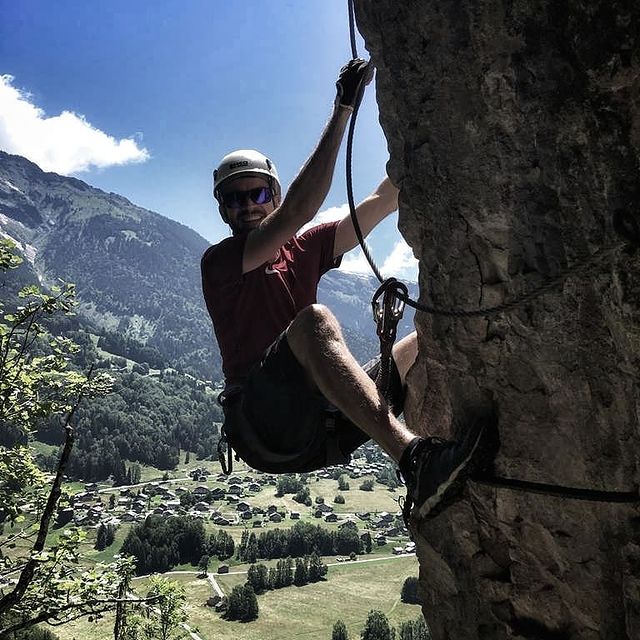
I try not to live too far away from hills and mountains throughout my life, as my sportive hobbies include
- mountain biking
- climbing
- bouldering
- via ferrata
- skiing/snowboarding.
On rainy days however, you will find me on my couch gaming, watching YouTube Videos about Space Time, reading a fantasy or sci-fi book or jumping around within VR slaying virtual boxes.